


How We Engineered Safe Access Inside a Commercial Aircraft Hangar
The Challenge: When Standard Solutions Don't Fit
A leading North American aviation maintenance facility faced a problem that most fall protection vendors couldn't solve. Technicians regularly worked at elevated heights—on aircraft wings, fuselages, engines, and tail assemblies—but the facility's complex constraints meant traditional fall protection solutions would fail in multiple ways.
Install a standard system and you'd either restrict worker mobility, interfere with critical fire suppression systems, or force expensive operational shutdowns. The facility needed something engineered specifically for their environment, not a catalog solution forced into place.
That's when they came to TAS.
What Made This Different
This wasn't a straightforward safety project. The aviation hangar presented a perfect storm of competing demands:
- Structural Complexity – The large open-span roof structure had limited natural anchor points. Most attachment locations were secondary structural members incapable of handling fall arrest loads safely.
- Operational Constraints – Aircraft maintenance operates on tight schedules. The facility couldn't afford extended shutdowns or equipment that would slow down technician movement and productivity.
- Fire Protection Integration – The hangar relied on a sophisticated foam-based fire suppression system with precisely positioned nozzles and coverage patterns. Any fall protection system had to work around this infrastructure without obstructing discharge zones or creating dead spots in suppression coverage.
- Regulatory Pressure – The facility operated under strict OSHA, ANSI, and aviation fire safety standards. A solution couldn't just appear compliant - it needed engineering documentation to prove it exceeded requirements.
- Height-Related Risk – Technicians accessed multiple aircraft types at various positions within the hangar. A partial solution wasn't acceptable. The system needed continuous protection coverage across the entire maintenance envelope.
Most fall protection vendors take one look at these constraints and offer compromises. TAS recognized this required custom engineering.
The TAS Solution
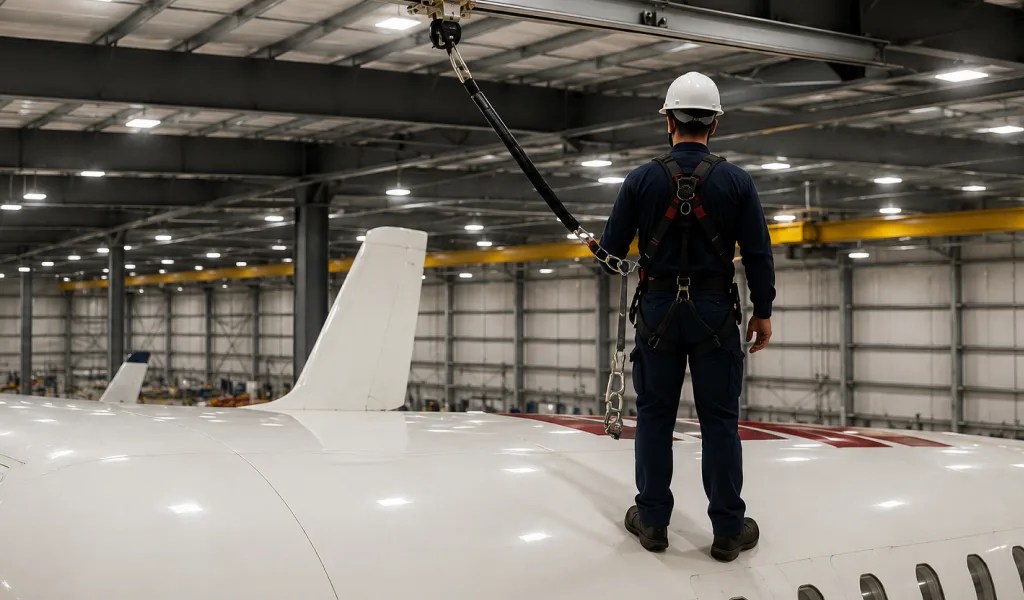
Rather than forcing a standard system into complex constraints, we engineered a custom overhead horizontal lifeline system designed specifically for aviation maintenance operations.
The Design Approach:
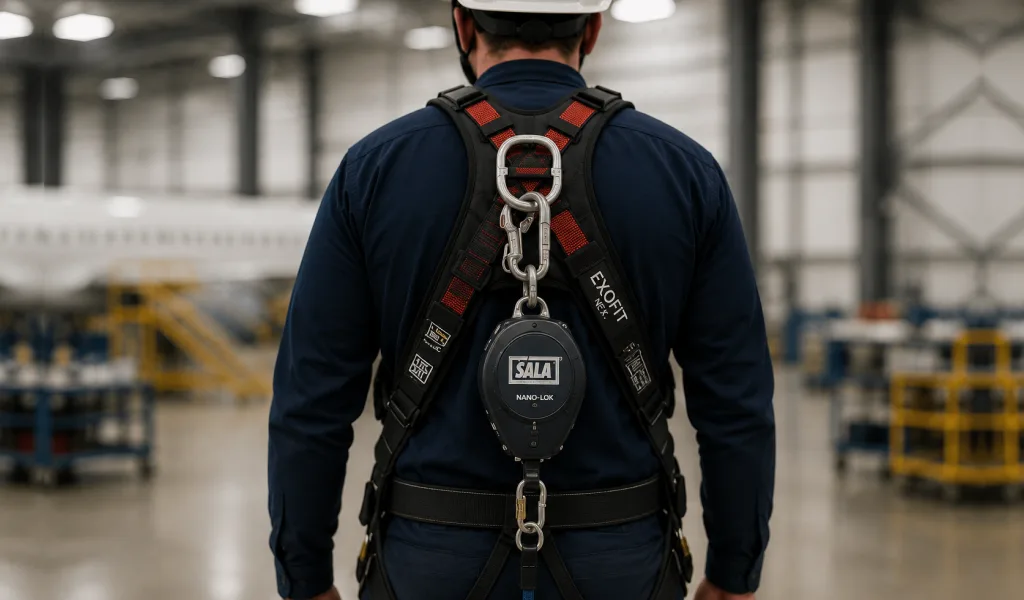
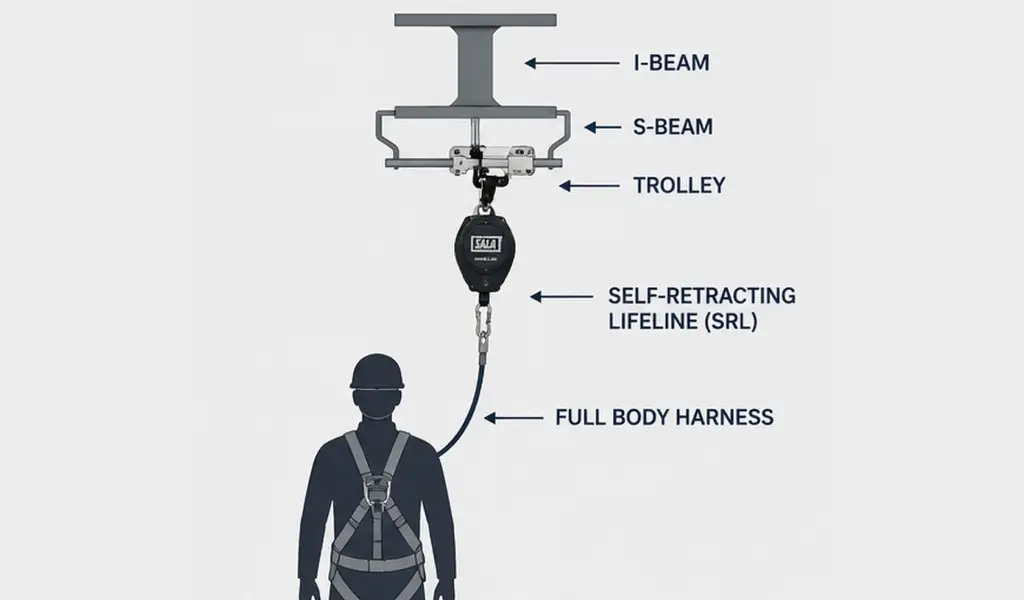
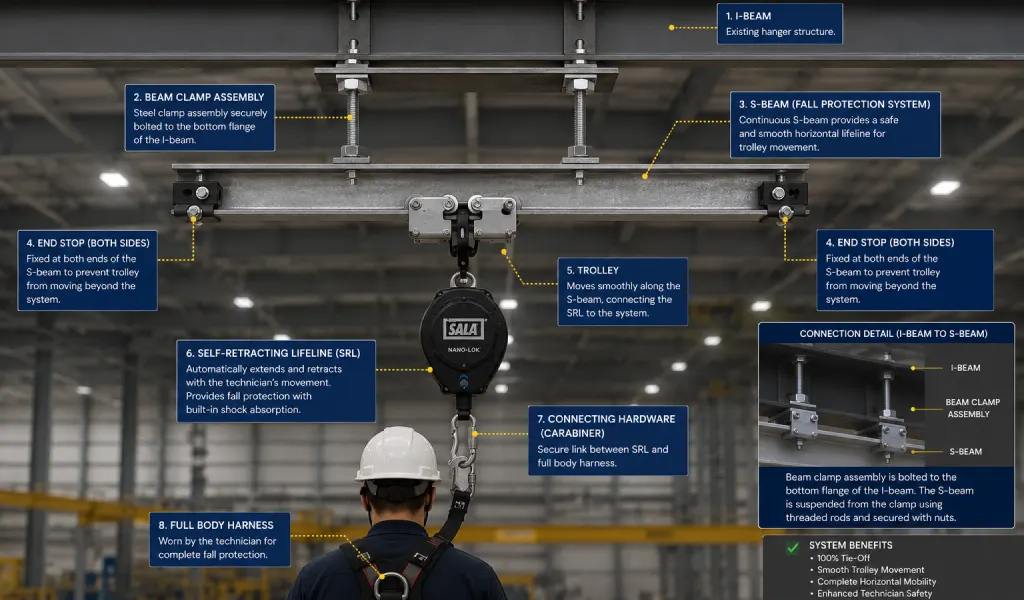
The solution centered on overhead lifeline spans engineered to cover the complete aircraft maintenance zone. Technicians would move freely across the hangar while remaining continuously protected, with low-friction trolley systems and self-retracting lanyards (SRL) eliminating the need for repeated tie-off procedures.
What We Built:
- Overhead horizontal lifeline spans covering the entire aircraft work envelope
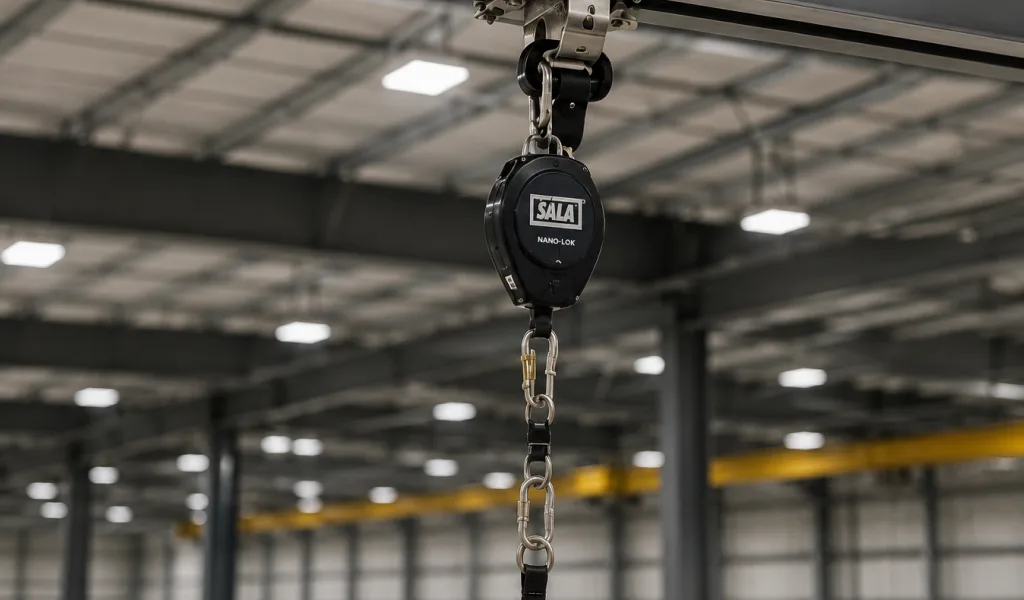
- Low-friction trolley systems with integrated self-retracting lanyards for continuous protection
- Custom-engineered mounting brackets attached directly to primary roof trusses
- Structural load analysis for every single connection point
- Fire suppression compatibility verification integrated into the design phase
Each support bracket was individually engineered based on the hangar's structural geometry, steel member properties, and anticipated arrest loads to ensure safe load transfer into the primary structure.
The Engineering Process
This wasn't engineering-by-guesswork. Every decision was backed by rigorous structural analysis:
Phase 1: Structural Assessment
Our team conducted a detailed evaluation of the hangar's roof framing system. We documented load paths, analyzed member capacities, identified safe anchor locations, and mapped the geometry that would support a lifeline system.
Phase 2: Load Modeling & Verification
Using advanced engineering calculations and fall arrest load modeling, we verified anchor capacities and calculated dynamic fall arrest forces for both single and dual-user scenarios. Every anchor point was verified to exceed ANSI requirements with significant safety margins.
Phase 3: Fire Safety Integration
The foam-based suppression network was mapped in detail. Coverage zones and nozzle locations were cross-referenced against proposed lifeline layouts to ensure zero interference with emergency response capabilities. This integration happened during design, not after the fact.
Phase 4: Implementation Planning
We developed a detailed installation plan that preserved operational continuity, allowing the hangar to continue aircraft maintenance activities during system installation.
Key Design Features
Maximum Worker Mobility
The overhead arrangement eliminated the traditional fall protection bottleneck—constant tie-off and re-attachment procedures. Technicians could now move smoothly across maintenance zones, improving both safety and operational efficiency.
Structural Integrity You Can Trust
All connection points were engineered to transfer fall arrest loads directly into primary structural members, never relying on secondary elements. The system was designed to handle worst-case scenarios and still perform reliably.
Fire Protection Compatibility
Custom low-profile brackets were developed specifically to avoid interference with foam discharge nozzles and suppression coverage patterns. Safety couldn't come at the expense of facility fire protection.
Corrosion Resistance
High-humidity maintenance and wash-bay environments are harsh on protective systems. We specified corrosion-resistant coating systems throughout to ensure long-term durability with minimal maintenance requirements.
Regulatory Compliance
The system met or exceeded ANSI, OSHA, EN 795, and applicable aviation safety standards—not as an afterthought, but as the foundation of the design approach.
The Results
Before vs. After
| Before | After |
|---|
Why This Approach Matters
The aviation industry operates at the intersection of multiple demanding forces: worker safety is non-negotiable, operational efficiency directly impacts financial performance, regulatory compliance carries legal weight, and facility infrastructure must be protected.
This project reveals a critical principle: in complex environments, engineered solutions outperform standardized ones.
Most vendors offer products designed for average conditions. When your facility has unique constraints- existing infrastructure, operational demands, regulatory requirements - standard solutions create false choices: accept compromised safety, accept operational disruption, or accept non-compliance.
A properly engineered system doesn't force these choices. It solves for all of them.
Why Organizations Choose TAS for Complex Safety Engineering
Structural Engineering Foundation – We understand how loads transfer through buildings, so our anchor systems actually work under real-world conditions
Industry Expertise – Experience across aviation, manufacturing, energy, and logistics means we understand your operational realities and constraints
Compliance by Design – Standards compliance isn't a checklist item. It's built into every engineering decision from the start
Proven Track Record – 120+ complex projects across industries that required custom thinking, not catalog solutions
Operational Understanding – We design for real conditions: worker mobility, operational efficiency, maintenance access, and facility constraints all factored in
Your Facility. Safely Engineered.
Your facility isn't unique. But your constraints are. That's why standard solutions won't work - engineering will. Whether you operate aircraft hangars, manufacturing facilities, data centers, power plants, or any high-risk environment where fall protection must coexist with operational demands, TAS delivers engineering-led solutions designed for your unique constraints.
Ideas Are Easy. Execution Is Engineering.
Our team helps turn complex concepts into buildable solutions.